Gate Metals Zone: Rethinking Metal Trading Strategies in a Shifting Macro Landscape

Beginner
Quick Reads
Last Updated 2026-03-24 19:26:12
Reading Time: 1m
As global economic signals become increasingly mixed, capital allocation strategies are shifting in response. Metal assets—valued both for their safe-haven characteristics and their cyclical market potential—are drawing renewed attention in today’s heightened volatility. This article examines how the metals sector demonstrates strategic value amid these evolving market dynamics, focusing on capital flows, price structures, and digital trading instruments.

Capital Repositioning: The Dual Role of the Metals Sector

As global growth momentum remains uncertain, market sentiment continues to swing between defensive strategies and positioning for recovery. In this context, metals have naturally become a central focus for capital reassessment.

For instance, gold has long served as a hedge against risk, while silver offers both safe-haven and industrial value. When uncertainty escalates, trading activity in these assets typically rises. In contrast, industrial metals like copper and aluminum are more directly tied to the prospects for infrastructure and manufacturing. If the market anticipates stronger demand, prices may begin to reflect that growth outlook ahead of time. This dual structure—balancing defense and growth—gives the metals sector strategic allocation relevance under a variety of macroeconomic scenarios.

Drivers of Sharp Price Swings

The recent rapid shifts in metal prices are generally the result of multiple, intertwined factors rather than a single event.

  • Ongoing revisions to global economic data are forcing markets to continually reassess future demand. Regional differences in economic recovery directly affect consumption and manufacturing expectations.

  • Fluctuations in energy prices and transportation costs have a direct impact on mining and smelting operations. When supply-side costs change, market pricing models are re-evaluated.

The rise of institutional capital and algorithmic trading systems has also made prices react even faster to new data. Significant policy statements or economic indicators can trigger notable price swings in a short period.

Market Dynamics Amplified by Volatility

When volatility increases, trading dynamics in the metals market evolve:

  • Price ranges form in shorter timeframes

  • Sector rotation accelerates

  • Entry and exit decisions face greater time sensitivity

Capital can shift quickly between precious and industrial metals, causing the market’s focus to pivot frequently. In this fast-paced environment, access to timely information and efficient execution are critical.

The Structural Edge of Digital Trading
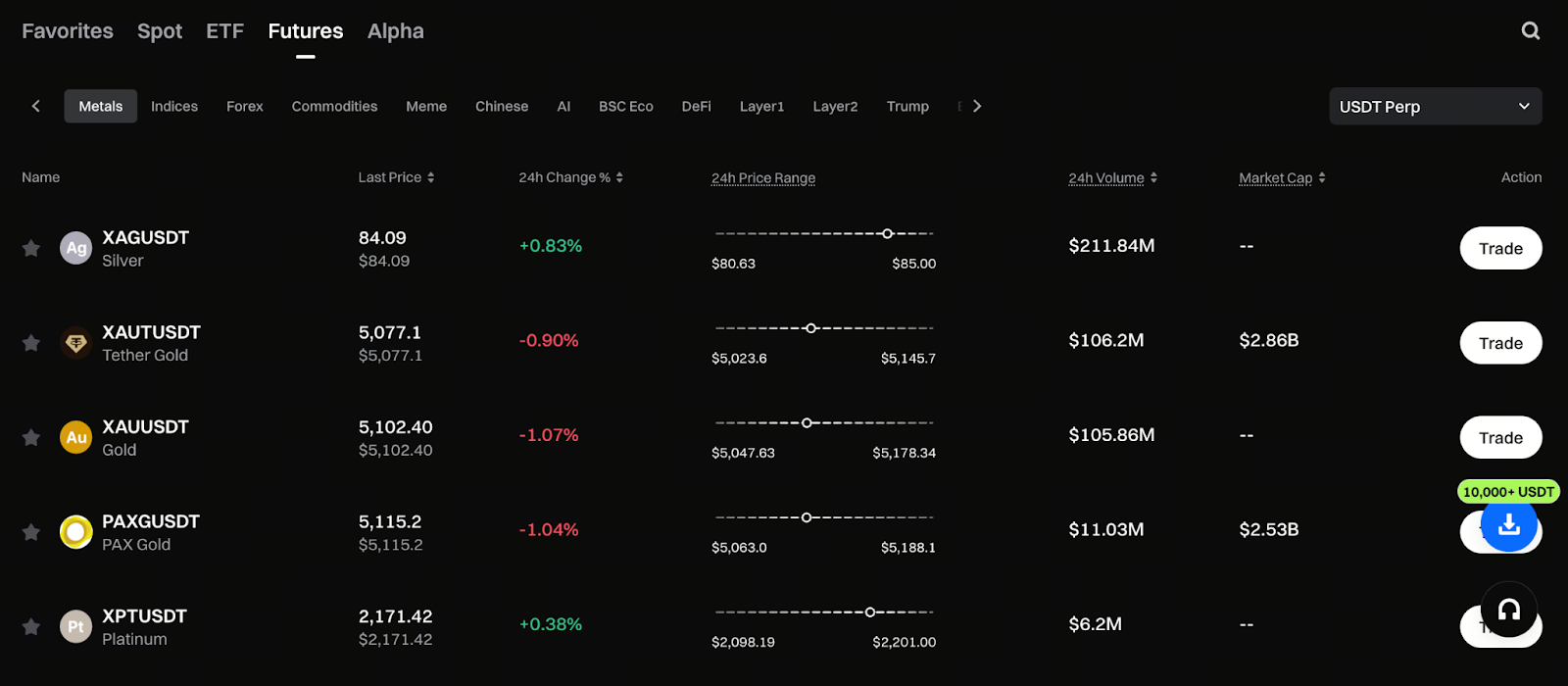
Structural Advantages of the Digital Trading Environment

As commodity markets go digital, participation is fundamentally different from traditional physical or floor-based trading. For example, Gate’s dedicated Metals Zone consolidates a range of metal products, allowing users to monitor prices and execute trades on a single platform. This integrated setup reduces the friction of switching between platforms and improves decision-making speed.

During periods of rapid market movement, a stable matching engine and transparent data structure help maintain smooth operations and minimize risks from latency or information gaps.

Get started in Gate’s Metals Zone: https://www.gate.com/price/futures/category-metals/usdt

24/7 Market Flexibility

Traditional commodity markets are bound by limited trading hours, but digital platforms offer nearly round-the-clock access. When significant policy decisions are announced outside standard sessions or global events cause sudden shifts, traders can adjust their strategies instantly—no need to wait for the market to open. This time flexibility enables capital to react to external shocks in real time, making it a major advantage for today’s market participants.

Metals’ Long-Term Role in Asset Allocation

Over the long term, metals continue to play an important role in global portfolios. Their key purposes include:

  • Hedging against inflation

  • Diversifying risk

  • Enabling cyclical investment strategies

Even as market conditions change rapidly, these core attributes remain. What’s different is the growing variety of participation options and the real-time, digital nature of trading tools.

Conclusion

As global capital reallocates, metals are once again at the center of strategic focus. The interplay between safe-haven demand and growth expectations is intensifying price volatility and capital rotation. In this environment, understanding how metal prices are formed—and leveraging digital trading solutions—can improve market participation and decision quality. Whether for defensive positioning or tactical trading, metals remain a key element in a diversified investment portfolio.

Author:  Allen
Disclaimer
* The information is not intended to be and does not constitute financial advice or any other recommendation of any sort offered or endorsed by Gate.
* This article may not be reproduced, transmitted or copied without referencing Gate. Contravention is an infringement of Copyright Act and may be subject to legal action.

Related Articles

What is Fartcoin? All You Need to Know About FARTCOIN
Intermediate

What is Fartcoin? All You Need to Know About FARTCOIN

Fartcoin (FARTCOIN) is a representative meme coin within the Solana ecosystem based on an AI-driven narrative. Its core concept originated from an experiment aimed at exploring the "boundaries between AI Agents and humor." More than just a digital asset with social attributes, the project deeply couples absurd humor culture with on-chain financial logic by integrating autonomous AI interaction models.
2026-04-04 22:01:19
Gold Price Forecast for the Next Five Years: 2026–2030 Trend Outlook and Investment Implications, Could It Reach $6,000?
Beginner

Gold Price Forecast for the Next Five Years: 2026–2030 Trend Outlook and Investment Implications, Could It Reach $6,000?

Analyze current gold price trends alongside authoritative five-year forecasts, integrating an evaluation of market risks and opportunities. This gives investors insight into the potential trajectory of gold prices and the main drivers expected to shape the market over the next five years.
2026-03-25 18:13:30
Aster vs Hyperliquid: Which Perp DEX Will Prevail?
Beginner

Aster vs Hyperliquid: Which Perp DEX Will Prevail?

Aster and Hyperliquid are the two representative protocols of the "purpose-built L1 path" within the current decentralized perpetual exchange (Perp DEX) sector. As a pioneer in the field, Hyperliquid has built a deep liquidity moat through its highly mature order book architecture and strong community consensus. Conversely, Aster, as a rising challenger, seeks to leapfrog the competition in high-performance trading through more aggressive multi-chain aggregation logic, private transaction modules, and an underlying execution environment optimized for 2026 market demands.
2026-03-24 11:58:33
AI-Native Settlement Layers: How United Stables Is Building the Next Financial Rail
Beginner

AI-Native Settlement Layers: How United Stables Is Building the Next Financial Rail

Stablecoins were originally designed as dollar substitutes within exchanges, primarily used for asset pricing and trade settlement. As on-chain financial ecosystems have matured, their role has expanded beyond simple payments to include collateral assets, cross-chain liquidity mediums, and unified settlement units. In particular, as AI systems and automated agents begin to participate directly in economic activity, demand has risen sharply for programmable value units capable of instant settlement. This shift is pushing stablecoins toward the role of foundational financial infrastructure.
2026-03-25 03:16:17
Aerodrome Tokenomics: How ve(3,3) Powers Base's Most Profitable DEX
Beginner

Aerodrome Tokenomics: How ve(3,3) Powers Base's Most Profitable DEX

AERO is the native token of Aerodrome Finance, a core decentralized exchange and liquidity protocol in the Base ecosystem. It is primarily used for liquidity incentives and ecosystem operations. veAERO is a governance NFT that users receive by locking AERO, representing both voting power and the right to share protocol revenue. Through a dual track structure of AERO as a utility token and veAERO as a governance credential, Aerodrome separates liquidity usage value from long term governance power, allowing participants to act as liquidity providers, governance decision makers, and revenue sharers within the same system.
2026-03-25 06:40:31
Hybrid Collateral Stablecoins: Inside United Stables' Stability and Yield Architecture
Beginner

Hybrid Collateral Stablecoins: Inside United Stables' Stability and Yield Architecture

In the early stages of the crypto market, traditional stablecoins mainly relied on single-reserve or single-collateral models. Their primary focus was price stability and payment convenience, which allowed them to become foundational tools for on-chain trading and capital flows. As the market has entered a more mature financial phase, however, this structure has begun to reveal limitations, including high concentration risk and the difficulty of balancing liquidity with yield. These constraints have driven the evolution toward multi-layer collateral and portfolio-based designs, such as the dual-layer hybrid collateral architecture proposed by United Stables, which seeks to redefine the underlying logic of stable assets.
2026-03-25 03:17:39





