Gate Alpha Profit Challenge: Trade Gate Fun Tokens to Share 1,000 GT

Beginner
Quick Reads
Last Updated 2026-03-28 17:09:50
Reading Time: 1m
Join the Gate Alpha Profit Challenge—trade Gate Fun tokens to maximize your earnings and compete for a share of the 1,000 GT prize pool. Sign up today to begin your profit journey.

Gate Alpha Profit Challenge Overview
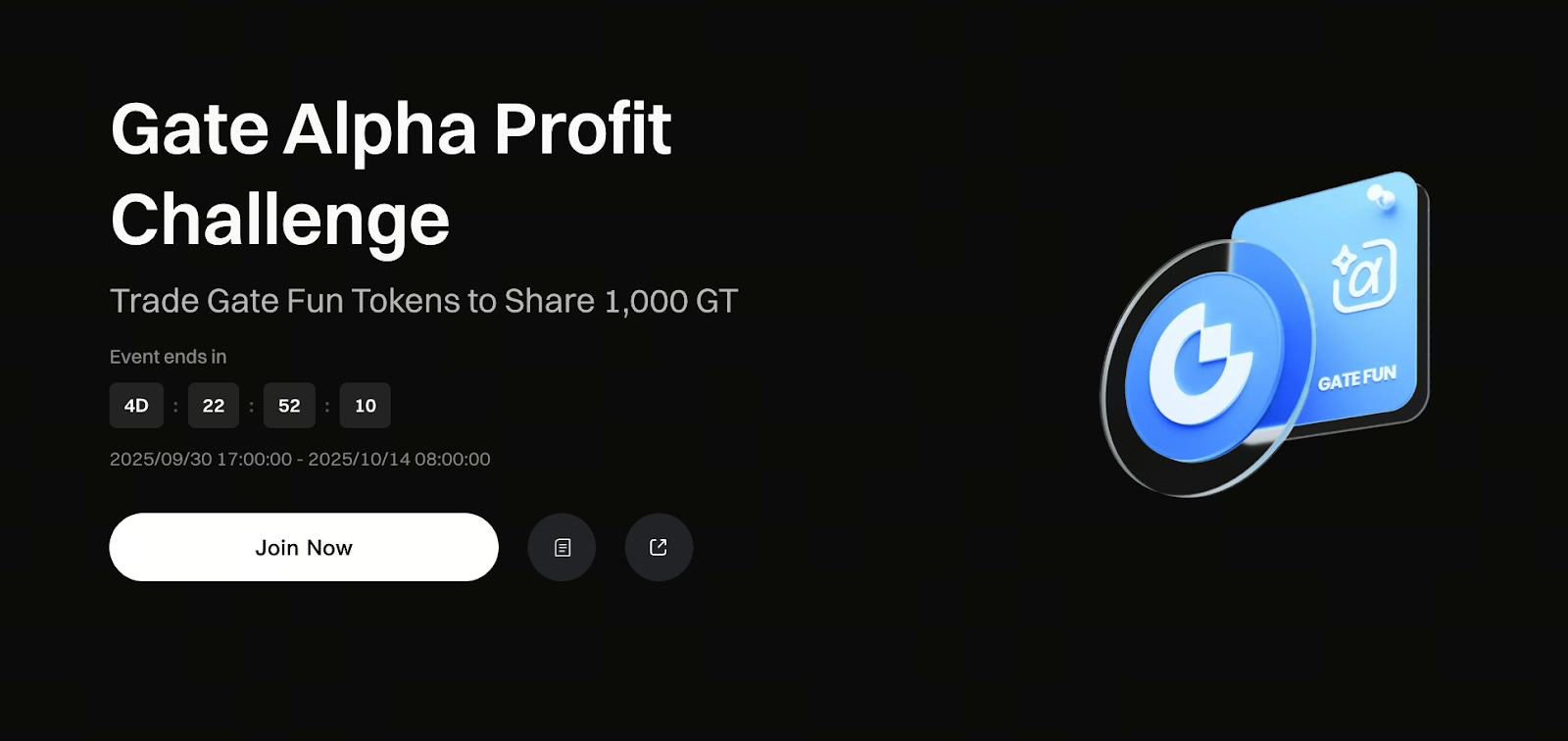

Image: https://www.gate.com/campaigns/2143Alpha

Gate Alpha has recently introduced a new Profit Challenge. It offers users the chance to demonstrate trading expertise and earn rewards by trading tokens launched via Gate Fun. During the event, participants trade Gate Fun tokens and compete to achieve the highest profits for a share of the substantial prize pool.

How to Join the Gate Alpha Profit Challenge

Getting involved in this Profit Challenge is simple: just trade Gate Fun tokens through Gate Alpha during the event period, ensuring all trades are completed on Gate Alpha. Please note: only trades executed on Gate Alpha count toward the rankings; trades through other platforms or channels are excluded.

  • Sign up: Click the “Join Now” button, complete your registration, and start participating.
  • Trade Gate Fun tokens: During the event window, trade tokens launched via Gate Fun on Gate Alpha.
  • Accumulate profits: Your ranking will be based on your trading profits.
  • Check rankings and rewards: Gate Alpha will rank users by their final profit and distribute prizes based on these rankings.

Event Duration & Rules

  • Event Period: September 30, 2025, 09:00 UTC – October 14, 2025, 00:00 UTC
  • How to Participate: Register and trade Gate Fun tokens on Gate Alpha during the event; trades will be tracked for ranking.
  • Ranking Criteria: Only profits from Gate Fun token trades made via Gate Alpha will be counted; trades from other channels are excluded.
  • Gate Alpha will issue all rewards within 14 business days after the event concludes.

Prize Structure & Ranking Standards

Gate Alpha awards prizes based on trading profits during the event, following these tiers:

  • TOP 1: 50 GT
  • TOP 2: 30 GT
  • TOP 3: 20 GT
  • TOP 4 – 10: 10 GT each
  • TOP 11 – 100: 3 GT each
  • TOP 101 – 1000: 0.62 GT each

All users who achieve positive profits will receive a prize; higher rankings receive larger rewards. Ultimately, the top 1,000 participants will split a total prize pool of 1,000 GT.

How to Maximize Your Profits

  • Analyze market volatility: Gate Fun token prices can fluctuate widely, so monitoring market trends and price movements helps you identify optimal trading opportunities for higher returns.
  • Strategically plan your trades: Use tactics such as dollar-cost averaging or arbitrage. During periods of high volatility, consider building or selling positions in batches to maximize profits.
  • Boost trading activity: Increasing your trading frequency and volume can lead to more profit opportunities.
  • Stay flexible: Adapting your trading approach during sudden price swings can reduce risk and expand your profit potential.

Important Notes & Risk Disclosures

  • No cheating permitted: Arbitrage, wash trading, or any form of manipulation is strictly forbidden. Any breach will result in immediate disqualification.
  • Price volatility risk: Some Gate Fun tokens may experience significant price swings. Participants must exercise prudent risk management and trade responsibly.
  • Only Gate Alpha trades count: Trades on other platforms or channels will not be considered for event rankings.
  • Gate Alpha will issue all rewards in GT tokens within 14 business days following the event. Token values may fluctuate during the prize distribution period.

Summary

The Gate Alpha Profit Challenge gives users a premier opportunity to earn rewards through trading. Trade Gate Fun tokens and compete for your share of a substantial 1,000 GT prize pool based on your final profit ranking. The higher your rank, the greater your reward. Click “Join Now” to register. Maximize your trading returns and claim your share of 1,000 GT!

Author: Max
Disclaimer
* The information is not intended to be and does not constitute financial advice or any other recommendation of any sort offered or endorsed by Gate.
* This article may not be reproduced, transmitted or copied without referencing Gate. Contravention is an infringement of Copyright Act and may be subject to legal action.

Related Articles

What is Fartcoin? All You Need to Know About FARTCOIN
Intermediate

What is Fartcoin? All You Need to Know About FARTCOIN

Fartcoin (FARTCOIN) is a representative meme coin within the Solana ecosystem based on an AI-driven narrative. Its core concept originated from an experiment aimed at exploring the "boundaries between AI Agents and humor." More than just a digital asset with social attributes, the project deeply couples absurd humor culture with on-chain financial logic by integrating autonomous AI interaction models.
2026-04-04 22:01:19
Gold Price Forecast for the Next Five Years: 2026–2030 Trend Outlook and Investment Implications, Could It Reach $6,000?
Beginner

Gold Price Forecast for the Next Five Years: 2026–2030 Trend Outlook and Investment Implications, Could It Reach $6,000?

Analyze current gold price trends alongside authoritative five-year forecasts, integrating an evaluation of market risks and opportunities. This gives investors insight into the potential trajectory of gold prices and the main drivers expected to shape the market over the next five years.
2026-03-25 18:13:30
Aster vs Hyperliquid: Which Perp DEX Will Prevail?
Beginner

Aster vs Hyperliquid: Which Perp DEX Will Prevail?

Aster and Hyperliquid are the two representative protocols of the "purpose-built L1 path" within the current decentralized perpetual exchange (Perp DEX) sector. As a pioneer in the field, Hyperliquid has built a deep liquidity moat through its highly mature order book architecture and strong community consensus. Conversely, Aster, as a rising challenger, seeks to leapfrog the competition in high-performance trading through more aggressive multi-chain aggregation logic, private transaction modules, and an underlying execution environment optimized for 2026 market demands.
2026-03-24 11:58:33
AI-Native Settlement Layers: How United Stables Is Building the Next Financial Rail
Beginner

AI-Native Settlement Layers: How United Stables Is Building the Next Financial Rail

Stablecoins were originally designed as dollar substitutes within exchanges, primarily used for asset pricing and trade settlement. As on-chain financial ecosystems have matured, their role has expanded beyond simple payments to include collateral assets, cross-chain liquidity mediums, and unified settlement units. In particular, as AI systems and automated agents begin to participate directly in economic activity, demand has risen sharply for programmable value units capable of instant settlement. This shift is pushing stablecoins toward the role of foundational financial infrastructure.
2026-03-25 03:16:17
ASTER Tokenomics: Buybacks, Burns, and Staking as the Value Foundation of ASTER in 2026
Beginner

ASTER Tokenomics: Buybacks, Burns, and Staking as the Value Foundation of ASTER in 2026

ASTER is the native equity and governance token of the Aster ecosystem, with its core value built upon a radical "Deflationary Engine." Beyond serving as a governance tool, ASTER integrates multiple utilities including staking rewards, trading fee discounts, and liquidity incentives. Through its deep integration with the upcoming dedicated Layer 1 mainnet, it enables direct value capture from protocol cash flow to token holders.
2026-03-25 07:38:07
Hybrid Collateral Stablecoins: Inside United Stables' Stability and Yield Architecture
Beginner

Hybrid Collateral Stablecoins: Inside United Stables' Stability and Yield Architecture

In the early stages of the crypto market, traditional stablecoins mainly relied on single-reserve or single-collateral models. Their primary focus was price stability and payment convenience, which allowed them to become foundational tools for on-chain trading and capital flows. As the market has entered a more mature financial phase, however, this structure has begun to reveal limitations, including high concentration risk and the difficulty of balancing liquidity with yield. These constraints have driven the evolution toward multi-layer collateral and portfolio-based designs, such as the dual-layer hybrid collateral architecture proposed by United Stables, which seeks to redefine the underlying logic of stable assets.
2026-03-25 03:17:39