Ethereum (ETH) Price Prediction: Price Trends and Influencing Factors

Last Updated 2026-03-31 03:22:44
Reading Time: 1m
As the foundation changes its fundraising approach, concerns within the community about ongoing sell-offs begin to diminish. The inflow of institutional funds and the market's new positioning on ETH indicate that ETH is being regarded as a core asset of the cryptocurrency financial system. Furthermore, predictions regarding ETH's future price are being made through AI models, accompanied by detailed chart analyses.

Analysis of the Core Factors Affecting ETH Price

1. The change in the use of funds by the Ethereum Foundation

Traditionally, the Ethereum Foundation (EF) has been a potential source of selling pressure that the market has focused on, especially when the ETH price approaches the upper range, as its sell-off often triggers a chain reaction in the market. However, the latest actions in May 2025 show signs of transformation.

EF borrowed $2 million worth of GHO stablecoins from the decentralized lending protocol Aave, using wrapped ETH (WETH) as collateral, obtaining funds without selling any ETH. This strategy is seen as EF starting to use DeFi tools for leverage operations, retaining assets while flexibly funding project development, demonstrating a long-term belief in Ethereum itself and innovative financial applications.

Marc Zeller, the founder of the Aave Chan Initiative (ACI), stated that Aave is designed for believers. He emphasized that such operations by the EF belong to a looping strategy, which is the logic of reusing funds from collateralized borrowing and reinvestment, widely used in the DeFi space to amplify profits and liquidity.

(Note: GHO is a decentralized stablecoin issued by Aave)

2. The market’s fear of ETH sell-off has cooled down.

According to on-chain data, EF has sold approximately 130,000 to 160,000 ETH over the past few years, and as of the end of 2024, it holds about 240,000 ETH. With this change in fundraising strategy, the community’s concerns over EF’s continuous selling have begun to diminish. Notably, as early as February this year, EF had deployed 45,000 ETH to major DeFi lending protocols including Aave, Compound, and Spark, with Aave receiving over 30,000 ETH in liquidity. These actions not only stabilize the ecosystem but also indirectly alleviate potential selling pressure in the market.

3. Signals for Institutions and New Capital Entry

In addition to the actions of EF, another driving force behind the rise in ETH prices comes from institutional capital inflows:

  • Sharplink Gaming (listed on NASDAQ) announced that it will invest $425 million to establish an ETH fund and explore the integration of blockchain gaming and entertainment applications.
  • The ETH spot trading platform has seen inflows for eight consecutive days, reflecting that funds are being repositioned, viewing ETH as the next opportunity window.

These trends indicate that the market no longer views ETH merely as a technical protocol token, but as a core asset of the crypto financial system, and it may even evolve into a sovereign asset of Web3.

ETH Technical Analysis and Forecast Outlook

Short to medium-term trend (1 - 3 months)

  • Key support zone: $2,200 ~ $2,400
  • Break through the resistance zone: $2,800 ~ $3,000

If the funds and narrative continue, along with a stabilization in Bitcoin’s market, ETH is expected to test the $3,000 round number again, which may trigger more arbitrage and leveraged funds to follow.

Long-term forecast (second half of 2025 to 2026)

As the Layer 2 ecosystem matures and Danksharding and EIP-4844 are implemented, ETH will reach new milestones in scalability and transaction costs, providing a more solid foundation for applications such as DeFi, gaming, AI, and RWA.

  • Optimistic forecast range: $4,500 ~ $6,000
  • Conservative prediction range: $3,200 ~ $4,000

Risk factors: Uncertainty of US regulation, delays in technological progress, pressure from Layer 2 competition

The DeFi narrative of ETH is rising again.

From the leveraged operations of this EF, it not only breaks the past convention of raising funds by selling coins but also refocuses the market on the integration potential of Ethereum and DeFi protocols. If established protocols like Aave and Compound can meet the demand of institutional users and national-level assets, it will drive the revaluation of ETH.

In addition, the logic of leveraging assets without selling them provides another module for capital management and stable liquidity for the entire market. This change is not just a minor adjustment in EF’s strategy, but a significant transformation in the financial logic of the Ethereum ecosystem towards an asset leverage cycle.

ETH price prediction

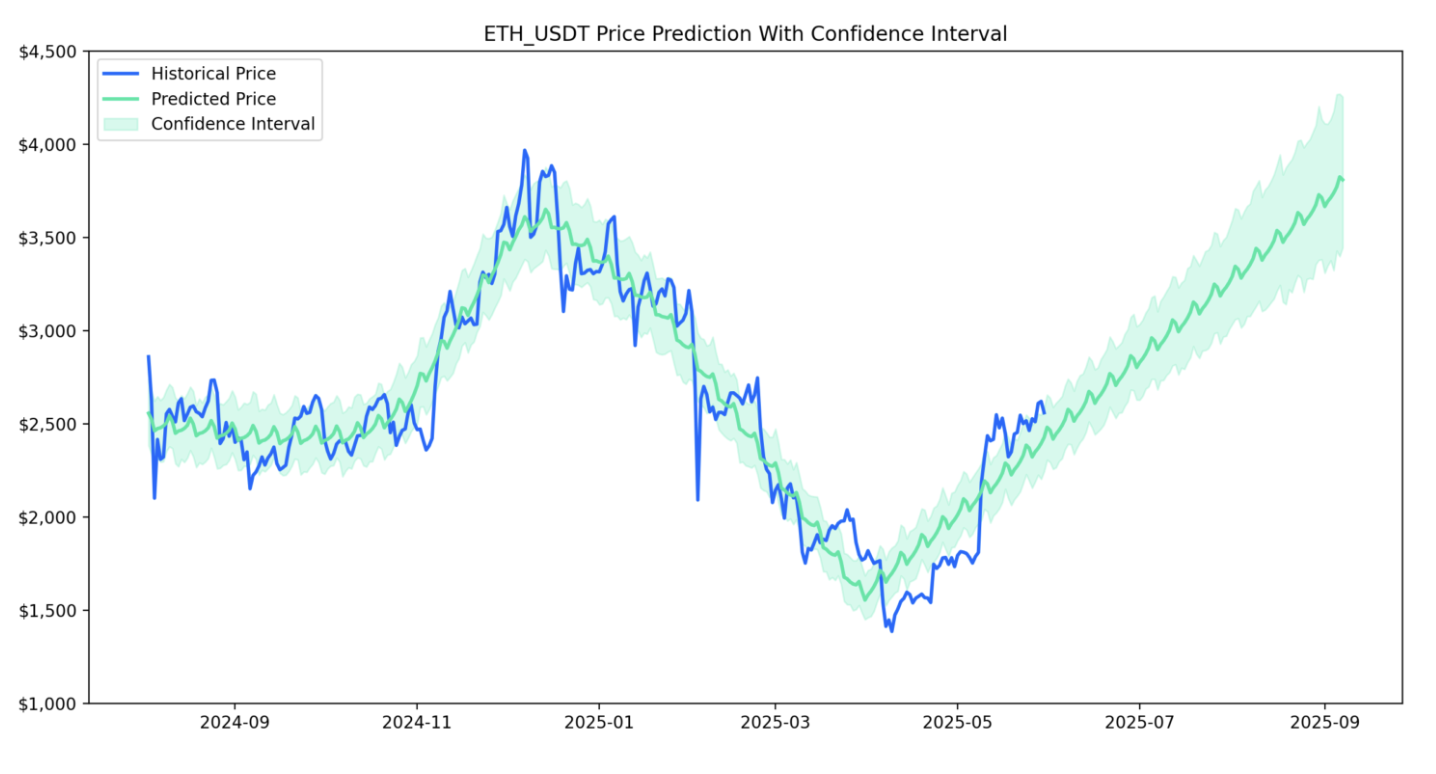
Through AI model data calculations, referencing past ETH prices and related information, predictions for future prices are made solely for data sharing purposes and not as investment advice. Refer to the chart below:

ETH price prediction trend

ETH price prediction and confidence interval
Start trading ETH spot immediately:https://www.gate.com/trade/ETH_USDT

Summary

The price performance of Ethereum is a comprehensive result of market sentiment and capital flow. The behavior of EF abandoning sell-offs and embracing DeFi is not just a simple asset allocation adjustment, but it could be a key step in driving the maturity of the entire Web3 financial model. With the development of Layer 2 and modular blockchains, ETH’s positioning as a trust layer and settlement layer will become more solid. The price may fluctuate in the future, but its irreplaceable narrative is gradually being strengthened.

Author: Allen
Disclaimer
* The information is not intended to be and does not constitute financial advice or any other recommendation of any sort offered or endorsed by Gate.
* This article may not be reproduced, transmitted or copied without referencing Gate. Contravention is an infringement of Copyright Act and may be subject to legal action.

Related Articles

What is Fartcoin? All You Need to Know About FARTCOIN
Intermediate

What is Fartcoin? All You Need to Know About FARTCOIN

Fartcoin (FARTCOIN) is a representative meme coin within the Solana ecosystem based on an AI-driven narrative. Its core concept originated from an experiment aimed at exploring the "boundaries between AI Agents and humor." More than just a digital asset with social attributes, the project deeply couples absurd humor culture with on-chain financial logic by integrating autonomous AI interaction models.
2026-04-04 22:01:19
Gold Price Forecast for the Next Five Years: 2026–2030 Trend Outlook and Investment Implications, Could It Reach $6,000?
Beginner

Gold Price Forecast for the Next Five Years: 2026–2030 Trend Outlook and Investment Implications, Could It Reach $6,000?

Analyze current gold price trends alongside authoritative five-year forecasts, integrating an evaluation of market risks and opportunities. This gives investors insight into the potential trajectory of gold prices and the main drivers expected to shape the market over the next five years.
2026-03-25 18:13:30
Aster vs Hyperliquid: Which Perp DEX Will Prevail?
Beginner

Aster vs Hyperliquid: Which Perp DEX Will Prevail?

Aster and Hyperliquid are the two representative protocols of the "purpose-built L1 path" within the current decentralized perpetual exchange (Perp DEX) sector. As a pioneer in the field, Hyperliquid has built a deep liquidity moat through its highly mature order book architecture and strong community consensus. Conversely, Aster, as a rising challenger, seeks to leapfrog the competition in high-performance trading through more aggressive multi-chain aggregation logic, private transaction modules, and an underlying execution environment optimized for 2026 market demands.
2026-03-24 11:58:33
AI-Native Settlement Layers: How United Stables Is Building the Next Financial Rail
Beginner

AI-Native Settlement Layers: How United Stables Is Building the Next Financial Rail

Stablecoins were originally designed as dollar substitutes within exchanges, primarily used for asset pricing and trade settlement. As on-chain financial ecosystems have matured, their role has expanded beyond simple payments to include collateral assets, cross-chain liquidity mediums, and unified settlement units. In particular, as AI systems and automated agents begin to participate directly in economic activity, demand has risen sharply for programmable value units capable of instant settlement. This shift is pushing stablecoins toward the role of foundational financial infrastructure.
2026-03-25 03:16:17
Aerodrome Tokenomics: How ve(3,3) Powers Base's Most Profitable DEX
Beginner

Aerodrome Tokenomics: How ve(3,3) Powers Base's Most Profitable DEX

AERO is the native token of Aerodrome Finance, a core decentralized exchange and liquidity protocol in the Base ecosystem. It is primarily used for liquidity incentives and ecosystem operations. veAERO is a governance NFT that users receive by locking AERO, representing both voting power and the right to share protocol revenue. Through a dual track structure of AERO as a utility token and veAERO as a governance credential, Aerodrome separates liquidity usage value from long term governance power, allowing participants to act as liquidity providers, governance decision makers, and revenue sharers within the same system.
2026-03-25 06:40:31
Hybrid Collateral Stablecoins: Inside United Stables' Stability and Yield Architecture
Beginner

Hybrid Collateral Stablecoins: Inside United Stables' Stability and Yield Architecture

In the early stages of the crypto market, traditional stablecoins mainly relied on single-reserve or single-collateral models. Their primary focus was price stability and payment convenience, which allowed them to become foundational tools for on-chain trading and capital flows. As the market has entered a more mature financial phase, however, this structure has begun to reveal limitations, including high concentration risk and the difficulty of balancing liquidity with yield. These constraints have driven the evolution toward multi-layer collateral and portfolio-based designs, such as the dual-layer hybrid collateral architecture proposed by United Stables, which seeks to redefine the underlying logic of stable assets.
2026-03-25 03:17:39





