BTC Price Prediction: Bitcoin Drops 8.3% From Peak, Can $113,800 Hold Key Cycle Threshold?

Last Updated 2026-03-29 14:53:46
Reading Time: 1m
Bitcoin's (BTC) recent price movements have renewed debate in the market about the four-year halving cycle. Additionally, the inclusion of Bitcoin in 401(k) retirement plans could be a catalyst, providing ongoing liquidity and supporting long-term buying pressure.

Preface

Recent movements in Bitcoin (BTC) prices have once again fueled debates about the four-year halving cycle. According to on-chain analytics firm Glassnode, while institutional investments and ETF flows are reshaping the market structure, Bitcoin’s current performance closely mirrors historical cycles.

Is the Bitcoin Price Cycle Entering Its Later Stages?

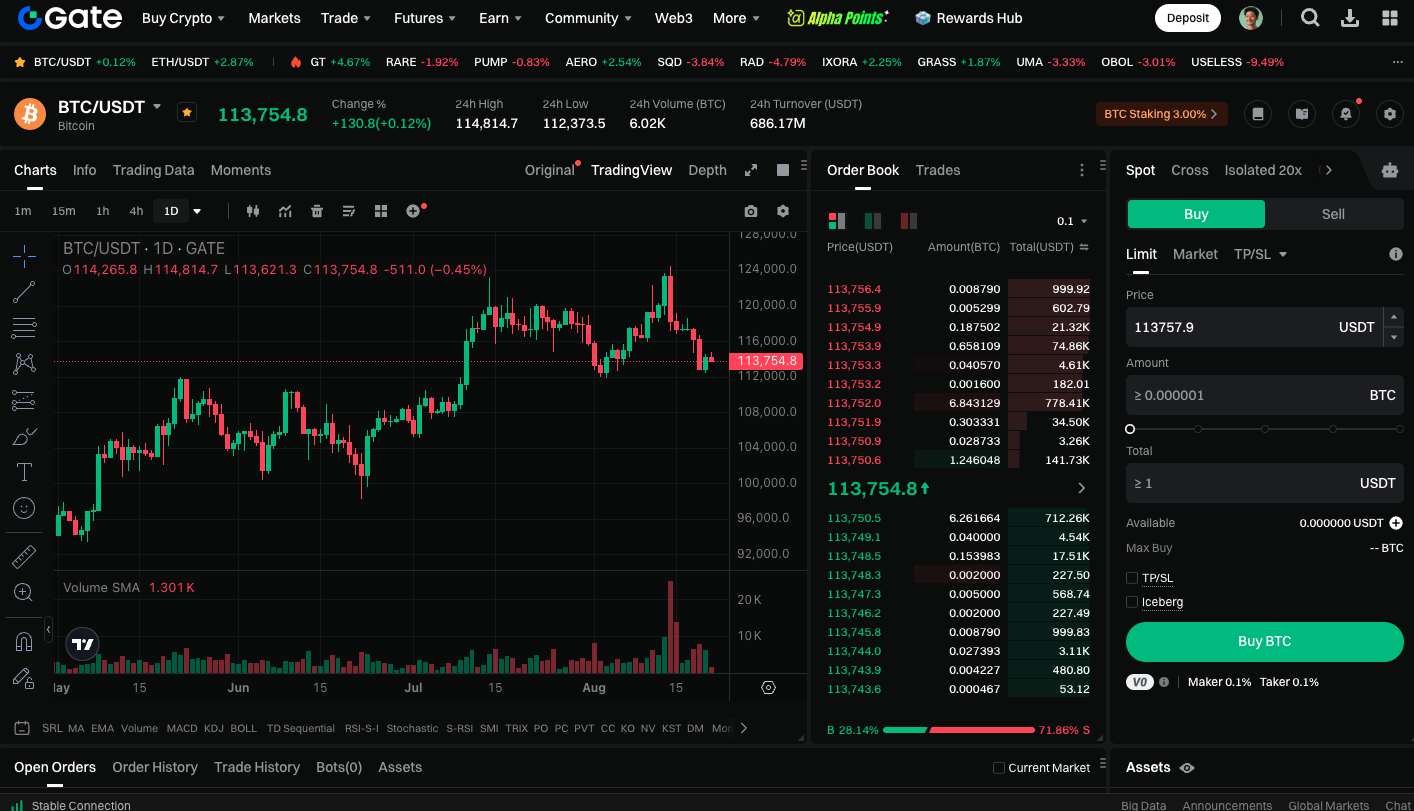
On August 14, 2025, Bitcoin hit an all-time high of around $124,128, followed by profit-taking that led to a price decline to $113,800—a drop of about 8.3%. Glassnode observes that the profit-taking activity among long-term holders (those holding for over 155 days) now matches the scale seen during previous peak periods, which could signal that the market is moving into the latter part of the cycle. Meanwhile, the intensity of capital inflows has started to cool. Data from Farside Investors shows that over the past four trading days, spot Bitcoin ETFs saw a net outflow of about $975 million, indicating that some investors are scaling back positions near recent highs.

Investor Appetite Shifts Toward High-Volatility Assets

With demand slowing, the market has increasingly turned toward volatility-based trading strategies. Glassnode notes that open interest in major altcoin derivatives markets once surpassed $60 billion. Although it later declined by about $2.5 billion, this demonstrates ongoing speculative interest. If Bitcoin follows its historical halving pattern, a new peak may occur around October. In both the 2018 and 2022 cycles, highs occurred roughly 550 days after halving, which is closely aligned with the current stage of the cycle.

Has the Four-Year Cycle Broken Down?

Not all analysts agree that the halving cycle still holds. Some institutions argue that with more corporate treasuries and pension funds allocating to Bitcoin, this market cycle may diverge from prior patterns.

Investor Jason Williams points out that the top 100 corporate holders collectively own nearly 1 million BTC, signaling a fundamental shift in market structure. Bitwise CIO Matt Hougan goes further: “The four-year Bitcoin cycle is dead,” he asserts, predicting that 2026 will still be “a year of growth for Bitcoin.”

Potential Impact of 401(k) Retirement Plans

Another often-overlooked catalyst is the inclusion of Bitcoin within 401(k) retirement plans—a market with trillions of dollars under management. Even a small allocation to Bitcoin could bring sustained liquidity and long-term buy-side demand. Key features of including Bitcoin in 401(k) plans are:

  • Long-term horizon: Retirement funds tend to hold assets for decades, which may reduce short-term market volatility.
  • Systematic contributions: Fixed monthly payroll deductions create persistent buying pressure.
  • Institutional management: Major asset managers must make direct allocations, further expanding the scope of regulated demand.

To trade BTC spot, visit: https://www.gate.com/trade/BTC_USDT
Conclusion

With Bitcoin trading at roughly $113,800 at the time of writing, the asset sits at a pivotal juncture in its cycle. Another record high may be reached by October if support holds and the uptrend resumes. If demand continues to lag, a retest of the key psychological $110,000 level may occur.

Author: Allen
Disclaimer
* The information is not intended to be and does not constitute financial advice or any other recommendation of any sort offered or endorsed by Gate.
* This article may not be reproduced, transmitted or copied without referencing Gate. Contravention is an infringement of Copyright Act and may be subject to legal action.

Related Articles

What is Fartcoin? All You Need to Know About FARTCOIN
Intermediate

What is Fartcoin? All You Need to Know About FARTCOIN

Fartcoin (FARTCOIN) is a representative meme coin within the Solana ecosystem based on an AI-driven narrative. Its core concept originated from an experiment aimed at exploring the "boundaries between AI Agents and humor." More than just a digital asset with social attributes, the project deeply couples absurd humor culture with on-chain financial logic by integrating autonomous AI interaction models.
2026-04-04 22:01:19
Gold Price Forecast for the Next Five Years: 2026–2030 Trend Outlook and Investment Implications, Could It Reach $6,000?
Beginner

Gold Price Forecast for the Next Five Years: 2026–2030 Trend Outlook and Investment Implications, Could It Reach $6,000?

Analyze current gold price trends alongside authoritative five-year forecasts, integrating an evaluation of market risks and opportunities. This gives investors insight into the potential trajectory of gold prices and the main drivers expected to shape the market over the next five years.
2026-03-25 18:13:30
Aster vs Hyperliquid: Which Perp DEX Will Prevail?
Beginner

Aster vs Hyperliquid: Which Perp DEX Will Prevail?

Aster and Hyperliquid are the two representative protocols of the "purpose-built L1 path" within the current decentralized perpetual exchange (Perp DEX) sector. As a pioneer in the field, Hyperliquid has built a deep liquidity moat through its highly mature order book architecture and strong community consensus. Conversely, Aster, as a rising challenger, seeks to leapfrog the competition in high-performance trading through more aggressive multi-chain aggregation logic, private transaction modules, and an underlying execution environment optimized for 2026 market demands.
2026-03-24 11:58:33
AI-Native Settlement Layers: How United Stables Is Building the Next Financial Rail
Beginner

AI-Native Settlement Layers: How United Stables Is Building the Next Financial Rail

Stablecoins were originally designed as dollar substitutes within exchanges, primarily used for asset pricing and trade settlement. As on-chain financial ecosystems have matured, their role has expanded beyond simple payments to include collateral assets, cross-chain liquidity mediums, and unified settlement units. In particular, as AI systems and automated agents begin to participate directly in economic activity, demand has risen sharply for programmable value units capable of instant settlement. This shift is pushing stablecoins toward the role of foundational financial infrastructure.
2026-03-25 03:16:17
Aerodrome Tokenomics: How ve(3,3) Powers Base's Most Profitable DEX
Beginner

Aerodrome Tokenomics: How ve(3,3) Powers Base's Most Profitable DEX

AERO is the native token of Aerodrome Finance, a core decentralized exchange and liquidity protocol in the Base ecosystem. It is primarily used for liquidity incentives and ecosystem operations. veAERO is a governance NFT that users receive by locking AERO, representing both voting power and the right to share protocol revenue. Through a dual track structure of AERO as a utility token and veAERO as a governance credential, Aerodrome separates liquidity usage value from long term governance power, allowing participants to act as liquidity providers, governance decision makers, and revenue sharers within the same system.
2026-03-25 06:40:31
Hybrid Collateral Stablecoins: Inside United Stables' Stability and Yield Architecture
Beginner

Hybrid Collateral Stablecoins: Inside United Stables' Stability and Yield Architecture

In the early stages of the crypto market, traditional stablecoins mainly relied on single-reserve or single-collateral models. Their primary focus was price stability and payment convenience, which allowed them to become foundational tools for on-chain trading and capital flows. As the market has entered a more mature financial phase, however, this structure has begun to reveal limitations, including high concentration risk and the difficulty of balancing liquidity with yield. These constraints have driven the evolution toward multi-layer collateral and portfolio-based designs, such as the dual-layer hybrid collateral architecture proposed by United Stables, which seeks to redefine the underlying logic of stable assets.
2026-03-25 03:17:39





