Raydium is a leading automated market maker (AMM) and decentralized finance infrastructure built on the Solana blockchain, launched in 2021 to address liquidity fragmentation and trading inefficiencies. This comprehensive guide explores Raydium's technical architecture powered by Solana's Proof of History consensus, market performance with a $320.9 million market capitalization and 249,645 token holders, and its strategic positioning within the DeFi ecosystem. The article covers RAY tokenomics with 555 million total supply, price volatility ranging from $0.134 to $16.83 historically, and current trading dynamics on Gate and major exchanges. It examines Raydium's core use cases including decentralized trading, liquidity provision, and yield farming opportunities, while addressing market challenges and community sentiment. Ideal for traders, liquidity providers, and DeFi participants seeking to understand Raydium's role in Solana's high-speed, low-cost trading infrastructure and learn participation strategies t
Raydium's Positioning and Significance
In 2021, Raydium was launched as an automated market maker (AMM) and liquidity provider built on the Solana blockchain, aiming to address inefficiencies in decentralized trading and liquidity provision.
As one of the first AMMs integrated with Serum on Solana, Raydium plays a critical role in the DeFi ecosystem, enabling seamless token swaps and liquidity pools with high-speed transactions.
As of 2026, Raydium has established itself as a key infrastructure component within the Solana ecosystem, with a market capitalization of approximately $320.9 million and over 249,645 holders.
This article will provide an in-depth analysis of its technical architecture, market performance, and future potential.
Origin and Development History
Background
Raydium was created in 2021 to solve the challenges of liquidity fragmentation and slow transaction speeds in decentralized exchanges.
It emerged during the rapid expansion of DeFi protocols, with the goal of providing fast, efficient, and low-cost trading experiences by leveraging Solana's high-performance blockchain.
Raydium's launch brought new possibilities for traders and liquidity providers seeking alternatives to Ethereum-based platforms.
Key Milestones
- 2021: Mainnet launch, achieving integration with Serum's central limit order book, enabling deeper liquidity and better price discovery.
- 2021: Token (RAY) listing on Gate.com and other major platforms, expanding accessibility to global users.
- 2022-2023: Ecosystem expansion with the introduction of concentrated liquidity pools and farming incentives, attracting significant total value locked (TVL).
- 2024-2025: Continued protocol upgrades focused on user experience improvements and cross-chain interoperability, solidifying its position in the Solana DeFi landscape.
With support from the Solana Foundation and an active community of developers, Raydium continues to enhance its technology, security measures, and real-world applications.
How Raydium Works
Decentralized Operation
Raydium operates on the Solana blockchain, a decentralized network of nodes distributed globally, eliminating reliance on banks or centralized intermediaries.
These nodes collaborate to validate transactions, ensuring the system remains transparent and resistant to attacks while granting users greater autonomy and enhancing network resilience.
Blockchain Foundation
Raydium's infrastructure is built on Solana's public, immutable blockchain, which records every transaction in a transparent ledger.
Transactions are grouped into blocks and linked through cryptographic hashes, forming a secure chain that anyone can verify without requiring intermediaries.
Solana's innovative architecture, utilizing Proof of History (PoH) alongside Proof of Stake (PoS), enables Raydium to process transactions with exceptional speed and low costs.
Ensuring Fairness
Raydium leverages Solana's Proof of Stake (PoS) consensus mechanism to validate transactions and prevent fraudulent activities such as double-spending.
Validators maintain network security by staking SOL tokens and processing transactions, earning rewards in return.
This approach is energy-efficient and supports high throughput, allowing Raydium to facilitate thousands of transactions per second.
Secure Transactions
Raydium employs public-private key cryptography to safeguard transactions:
- Private keys (similar to secret passwords) are used to authorize transactions
- Public keys (similar to account numbers) verify ownership and enable transparent tracking
This mechanism ensures fund security while maintaining pseudonymous user identities.
Additionally, Raydium's integration with Solana's ecosystem provides robust security audits and smart contract safeguards to protect user assets.
Circulation Overview
As of January 15, 2026, Raydium's circulating supply stands at 268,599,298.68 RAY tokens, with a total supply of 555,000,000 RAY and a maximum supply cap of 555,000,000 RAY, representing a fixed supply model.
The circulating supply represents approximately 48.40% of the total supply, with tokens entering the market through the project's distribution mechanisms, influencing supply and demand dynamics.
The distribution structure supports ecosystem development, with tokens allocated across community incentives, liquidity provision rewards, and protocol development initiatives.
Price Volatility
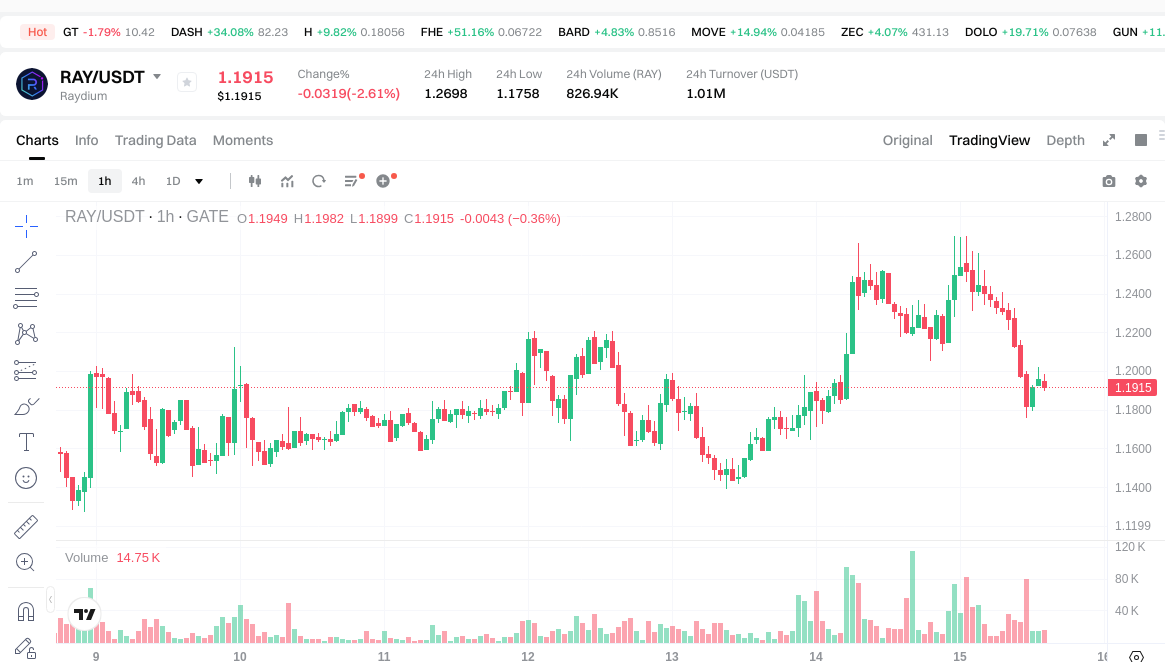
Raydium reached its all-time high price of $16.83 on September 13, 2021, driven by heightened market activity during the broader cryptocurrency bull market and increased adoption of Solana-based decentralized finance protocols.
Its lowest price of $0.134391 occurred on December 30, 2022, influenced by broader market downturns and reduced trading activity across decentralized exchanges.
These fluctuations reflect market sentiment, adoption trends, regulatory developments, and external macroeconomic factors affecting the cryptocurrency sector.
As of January 15, 2026, RAY is trading at $1.1947, showing a -2.21% change over the past 24 hours, with a 24-hour trading range between $1.1758 and $1.2698. Over different timeframes, RAY has demonstrated varied performance: -0.48% over 1 hour, +0.82% over 7 days, +27.33% over 30 days, and -77.46% over the past year.
Click to view the current RAY market price
On-Chain Metrics
- Market Capitalization: $320,895,582.13, ranking 183rd among cryptocurrencies with a market dominance of 0.019%
- 24-Hour Trading Volume: $1,018,207.32, indicating active trading participation
- Fully Diluted Valuation: $663,058,500.00, with the market cap representing 48.4% of the fully diluted valuation
- Token Holders: 249,645 addresses holding RAY tokens, reflecting user participation across the ecosystem
- Exchange Listings: Available on 44 cryptocurrency exchanges, providing broad accessibility for traders
Raydium Ecosystem Applications and Partners
Core Use Cases
Raydium's ecosystem supports multiple applications:
- Decentralized Finance (DeFi): As an automated market maker (AMM) on Solana, Raydium provides decentralized trading and liquidity provision through integration with Serum DEX.
- Liquidity Infrastructure: Raydium serves as a foundational component for introducing new and existing projects into the Solana ecosystem, enabling efficient token swaps and yield farming.
Strategic Partnerships
Raydium operates as part of the Solana blockchain ecosystem, leveraging its high-speed infrastructure. As a first-mover AMM within the Serum ecosystem, Raydium benefits from strategic positioning to onboard new protocols and projects.
Controversies and Challenges
Raydium faces the following challenges:
- Market Competition: Competition from other AMMs and DEXs within the Solana ecosystem and across multiple blockchains
- Price Volatility: Significant price fluctuations, with RAY experiencing a 77.46% decline over the past year
- Technical Dependencies: Reliance on Solana's network performance and stability
These issues have sparked discussions within the community while also driving continuous innovation in the protocol.
Raydium's community demonstrates strong activity, with 249,645 token holders as of January 15, 2026.
The protocol maintains an active presence on X platform through @raydiumprotocol, where discussions about protocol updates, liquidity incentives, and trading features generate significant engagement.
Sentiment on X shows mixed perspectives:
- Supporters highlight Raydium's high-speed trading capabilities and integration with Solana's ecosystem, viewing it as a key infrastructure component for DeFi on Solana.
- Critics focus on price volatility and market performance challenges, particularly the substantial year-over-year decline.
Recent trends show cautious optimism, with a 27.33% price increase over the past 30 days indicating recovering market interest.
Trending Topics
X users actively discuss Raydium's liquidity mining programs, trading volume metrics, and integration with new Solana projects, reflecting both its innovative potential and the challenges of competing in the evolving DeFi landscape.
- Official Website: Visit Raydium's official website for features, use cases, and latest updates.
- X Updates: On X platform, Raydium operates under @raydiumprotocol, sharing updates on protocol enhancements, liquidity pools, community events, and partnership announcements.
- Blockchain Explorer: Track Raydium's smart contract and transaction data on Solana Explorer.
How to Participate in Raydium?
- Purchase Options: Buy RAY on Gate.com and other major cryptocurrency exchanges
- Storage Solutions: Securely store RAY using Solana-compatible wallets such as Phantom or Solflare
- Participate in Ecosystem: Provide liquidity on Raydium's AMM platform to earn trading fees and potential rewards
- Explore DeFi: Utilize Raydium's trading interface to swap tokens and participate in yield farming opportunities
Summary
Raydium leverages Solana's blockchain technology to provide an efficient automated market maker, offering fast transaction speeds, low fees, and deep liquidity integration.
Its strategic positioning as a first-mover AMM on Solana, active community of 249,645 holders, and integration with the broader ecosystem make it a notable player in decentralized finance.
Despite facing price volatility and competitive pressures, Raydium's role as a liquidity infrastructure provider positions it as an important component of Solana's DeFi landscape.
Whether you're new to DeFi or an experienced trader, Raydium offers opportunities for participation in decentralized trading and liquidity provision.
FAQ
What is Crypto RAY and what is its main use case?
Raydium (RAY) is a token powering the Raydium decentralized exchange built on Solana. Its main use case is enabling fast, low-cost trading and liquidity provision for cryptocurrency traders and liquidity providers in the DeFi ecosystem.
How can I buy and store RAY tokens?
Purchase RAY tokens via MoonPay using credit card, bank transfer, or digital wallets. Store them in a secure Solana-compatible wallet for maximum security and accessibility within the Solana ecosystem.
What are the key features and technology behind RAY?
RAY is a high-speed distributed computing framework supporting millions of tasks per second with minimal latency. Key features include efficient task scheduling, resource management, and versatile distributed and local execution capabilities for machine learning applications.
What are the risks and security considerations when investing in RAY?
Key risks include regulatory uncertainty from Hong Kong and mainland China, market volatility, smart contract vulnerabilities, and operational challenges. Conduct thorough research and only invest what you can afford to lose.
How does RAY compare to other similar cryptocurrency projects?
RAY stands out with strong market capitalization and trading volume. As a Solana ecosystem token, it benefits from high throughput and low fees, offering competitive advantages over similar projects in both performance and investment potential.
What is the tokenomics and supply structure of RAY?
RAY has a 555 million token hard cap. The mining reserve comprises 34% of total supply(188.7m RAY), with approximately 1.9 million RAY emitted annually. 12% of trading fees are used for buyback. Most locked supply is allocated to mining reserves, partnerships, and advisors.
* The information is not intended to be and does not constitute financial advice or any other recommendation of any sort offered or endorsed by Gate.