Bitcoin vs Gold: The Safe-Haven Showdown


For centuries, gold has stood as the ultimate safe-haven asset and store of value. In recent years, Bitcoin – the first and largest cryptocurrency – has emerged as a digital rival, often hailed as “digital gold.” Both assets have passionate advocates: gold for its tangible stability, Bitcoin for its high-tech, high-growth potential. In this blog, we take a journalistic look at Bitcoin vs Gold, comparing their roles as stores of value, historical performance, volatility, merits as an inflation hedge, and what the future might hold for these two very different assets.

Bitcoin and Gold as Stores of Value
Store of value refers to an asset that can preserve (or increase) its worth over time. Gold’s reputation as a store of value is built on thousands of years of human history – it’s scarce, durable, and universally recognized. Bitcoin, launched in 2009, is a newcomer that quickly gained a following as a digital store of value due to its programmed scarcity and decentralized nature. Here’s how the two compare on key attributes:
- History & Trust: Gold has been used as a store of wealth for millennia (from ancient coins to modern central bank reserves), earning unmatched trust over time. Bitcoin, by contrast, has just over a decade of history. While it lacks a long track record, it has rapidly gained trust among tech-savvy investors and some institutions in its short lifespan.
- Scarcity: Gold’s supply grows slowly (about 1–2% per year through mining), and there is a finite amount in the earth’s crust. Bitcoin is even more strictly limited – its supply is capped at 21 million coins, with new bitcoins released on a predictable schedule that halves roughly every four years (an event known as the “halving”). Neither asset can be created at will, in stark contrast to fiat currencies which can be printed in unlimited quantities.
- Tangible vs Digital: Gold is physical and tangible – you can hold a gold bar or coin in your hand. This physicality means it needs secure storage and can be costly to transport. Bitcoin exists only digitally on a global network of computers (blockchain). It has no physical form, which makes it easily portable (you can send value across the world online) but also means it relies on internet and electricity to access.
- Divisibility & Utility: Bitcoin is highly divisible (you can spend a tiny fraction of a coin) and easily transacted, which adds to its utility as a modern store of value or even medium of exchange. Gold is less divisible in practical terms (shaving off grams from a bar is not convenient) and is not used directly in day-to-day transactions. However, gold does have practical uses – from jewelry to electronics – which provide a baseline demand beyond investment. Bitcoin’s value is driven purely by investor demand and its network usage, since it has no industrial use.
- Market Adoption: Gold is widely held by individuals, institutions, and even governments. Central banks collectively hold tens of thousands of tons of gold as part of their reserves, underscoring gold’s institutional acceptance. Bitcoin is in earlier stages of adoption – no central bank holds Bitcoin (yet), but it’s held by a growing number of retail investors, corporations, and even a few nations as legal tender. Its adoption trend is strong but it also faces regulatory scrutiny in many countries, which gold largely avoids at this point.
In short, gold offers the security of tradition and tangibility, while Bitcoin offers innovation and high-upside potential as a digital-age store of value. Next, let’s see how they’ve actually performed for investors.
Historical Price Performance
When it comes to price performance, the difference between gold and Bitcoin has been dramatic. Gold is known for its stability over the long run – it generally preserves wealth and outpaces inflation modestly, but it’s not known for huge price leaps in short periods. Bitcoin, on the other hand, has delivered staggering returns since its inception, but with extreme volatility.
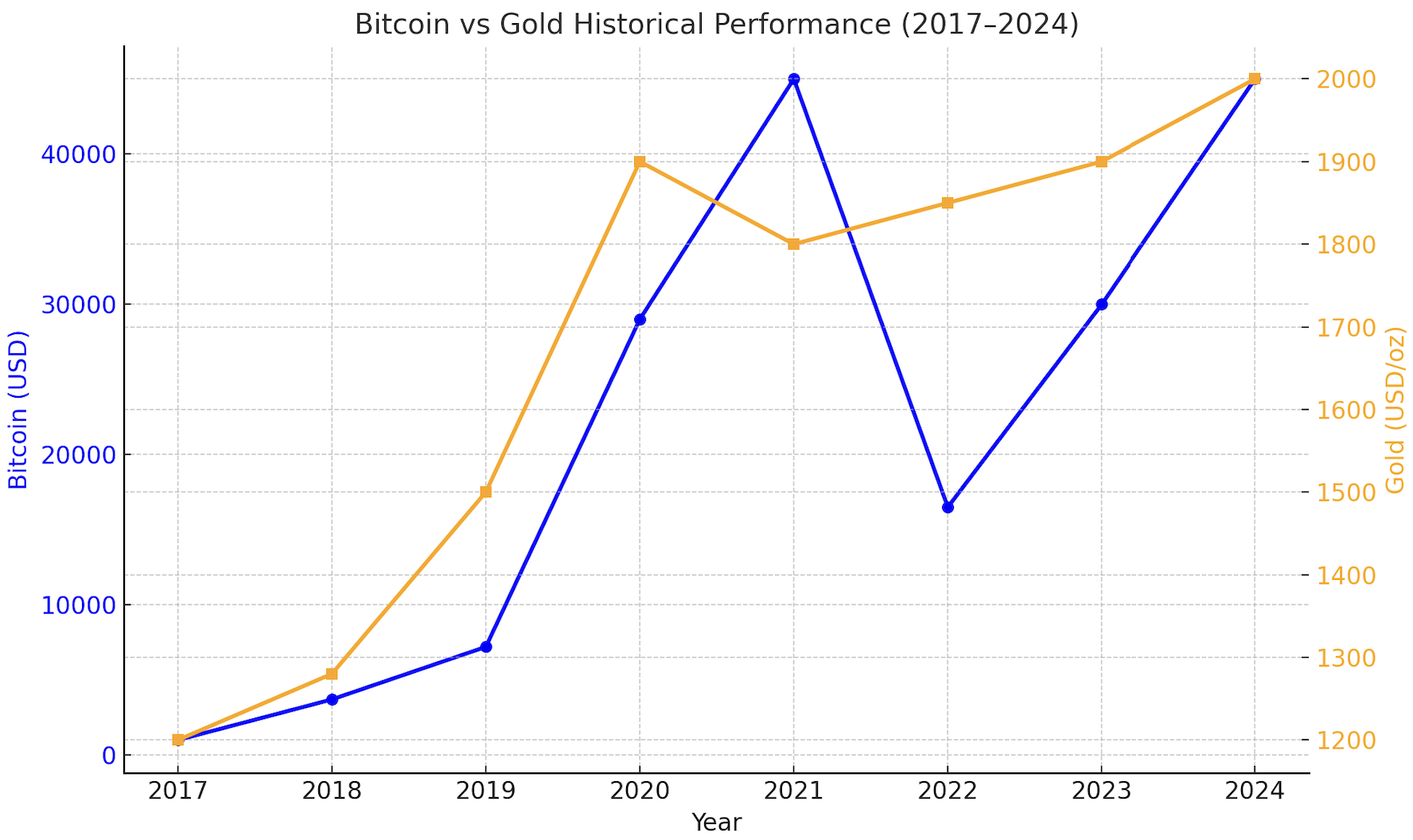
Over the past decade, Bitcoin has been the best-performing asset class in the world. In its early years, one bitcoin was virtually worthless – just a few cents. By 2011 it was only a few dollars, and a decade later it had exploded into the tens of thousands of dollars per coin. For example, five years ago (around 2016–2017), Bitcoin was trading under $1,000; today it often fluctuates in the $30,000–$50,000 range per coin. That is a rise of thousands of percent. Bitcoin’s growth has not been steady or smooth, however – it has experienced multiple boom-and-bust cycles (more on volatility later). Major bull runs in 2013, 2017, and 2020–2021 saw its price multiply rapidly, while intervening bear markets saw declines of 50% or more. Early investors who held through the turbulence have seen unparalleled gains: even accounting for pullbacks, Bitcoin’s long-term trend has been sharply upward.
Gold’s price performance has been far more steady and modest. A decade ago, in 2013, gold was around $1,300 per ounce. As of 2025, gold is roughly in the $1,900–$2,000 per ounce range. Over ten years, that’s a decent gain (about 50% higher in USD terms, not accounting for inflation). Gold hit an all-time high around $2,070 in 2020 amid pandemic uncertainty and again approached record levels during periods of high inflation in 2022–2023. But overall, gold’s price chart looks relatively flat compared to Bitcoin’s moonshot. Long-term holders of gold have seen their wealth preserved and slowly grown – for instance, over 20 years gold roughly quadrupled from the early 2000s to now – but they haven’t experienced anything like the explosive returns of Bitcoin.
One key difference between Bitcoin and gold is vividly illustrated by their price history. Over the past decade, Bitcoin’s price skyrocketed from under $100 in 2013 to nearly $70,000 at its 2021 peak, and remains in the tens of thousands in 2025. In contrast, gold’s price inched up gradually from roughly $1,300 per ounce to about $1,900 per ounce over the same period. The chart above (using a logarithmic scale due to Bitcoin’s huge gains) highlights Bitcoin’s exponential growth – far outpacing gold’s cumulative rise – but also shows Bitcoin’s jagged swings, in stark contrast to gold’s relatively steady line. In other words, Bitcoin would have vastly multiplied an investment made ten years ago, whereas gold would have yielded a modest, stable increase.
It’s worth noting that gold has shown its value over centuries. An often-cited example: an ounce of gold could buy a fine men’s suit a hundred years ago, and it still can today – a testament to gold’s long-term preservation of purchasing power. Bitcoin doesn’t have centuries of history, but its supporters argue that if it had existed over the same timeframe, its mathematically limited supply would similarly preserve value in the long run (and indeed greatly appreciate as adoption grows). Historically, gold’s price tends to rise during times of economic crisis or inflation, while Bitcoin’s historical performance has been more tied to technology adoption curves and liquidity in financial markets.
Volatility Comparison
Volatility is where Bitcoin and gold diverge dramatically. Gold is valued in part because it is a relatively stable store of value. Its price moves are usually gradual. Bitcoin, by contrast, is notoriously volatile.
- On a day-to-day basis, gold’s price might move 1% or less – a $20 swing on a $2,000 ounce would be typical. Significant gold moves of 5–10% in a day are very rare and usually tied to major geopolitical or economic events.
- Bitcoin, on any given day, can easily swing 5% up or down (sometimes much more). Double-digit percentage moves in a single day have happened during crises or frenzied market conditions. For example, in March 2020, when the COVID-19 panic hit markets, Bitcoin’s price plunged by roughly 50% in a couple of days – an extreme move that would be almost unthinkable for gold in such a short span. During the 2021 bull run, Bitcoin often surged or dropped thousands of dollars in a matter of hours on speculative fervor.
Over longer periods, gold’s volatility is low. Investors see gold as a safe, steady asset that may dip or rise by moderate percentages per year. Bitcoin, in contrast, has seen year-to-year moves that are extraordinary: it can quadruple in a year, or lose 70%+ of its value in a severe downturn. This high volatility means higher risk: an investor in Bitcoin must stomach severe swings in portfolio value, whereas a gold holder typically sees far less fluctuation in wealth.
Why is Bitcoin so much more volatile? A few reasons: Bitcoin is still a relatively young, emerging asset class, and its value is driven by speculation and changing narratives. Its market is smaller and less liquid than gold’s, so money moving in or out has a bigger impact on price. Regulatory news, hacks, or shifts in investor sentiment can trigger outsized responses. Gold’s market, on the other hand, is deeply established – it’s harder to shock a market that’s been around for centuries with millions of participants and a wide industrial base. Gold also has a sort of value anchor in its use and in central bank reserves, which dampens wild speculation. Bitcoin is still finding its true price discovery amid rapid growth and adoption.
That said, Bitcoin’s volatility has trended down slightly as it matures – the wild swings of its early years (when it could spike 1000% and crash 80% routinely) have somewhat tempered as the market grew. Still, compared to traditional assets (stocks, bonds, and even gold), Bitcoin remains extremely volatile. Gold’s role as a stabilizer in portfolios (it often moves inversely to risky assets in crises) is quite different from Bitcoin’s profile as a high-risk, high-reward asset that often trades more like a tech stock or high-beta investment.
Investors considering Bitcoin vs gold must weigh this volatility difference: gold offers peace of mind with relatively low volatility, whereas Bitcoin offers opportunity for high returns but with roller-coaster price action.
Share
Content
Bitcoin and Gold as Stores of Value
Historical Price Performance
Volatility Comparison
How to Buy Cryptocurrency


Trending Cryptocurrencies



2025 Bitcoin Investment Guide: How to Get Started and Make Profits

Everything beginners need to know about Bitcoin in 2025
How to invest in Bitcoin in 2025

2025 Bitcoin Price Prediction: Trump's Tariffs' Impact on BTC

2025 Bitcoin (BTC) Price Prediction: Can It Break Through $200,000?
Bitcoin’s Meteoric Past and Future: Price Surges, 2025 Predictions, and Long-Term Outlook

Bitcoin Formula

Kickstarter: Voting Mechanism and Token Distribution

Jupiter's Airdrop Strategy: Addressing Dilution and Fostering Community Participation

ETH Options Positioning Near 3,500, A Practical Read on January 30 Expiry Risk

What Is an XRP Bridge Currency?